
Chapter 6 · Equipment
Weapons
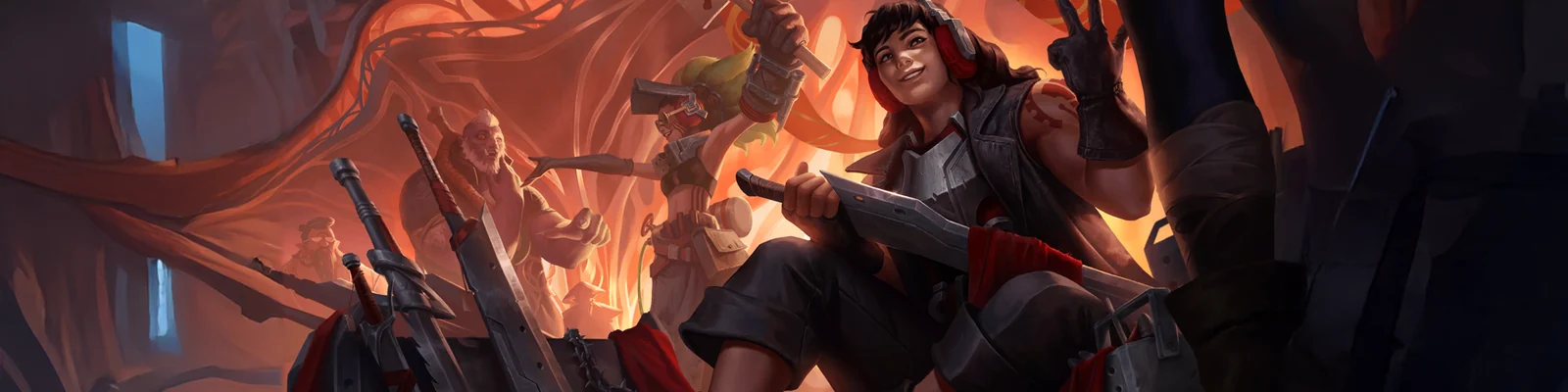
Your class grants you proficiency with a number of weapons, reflecting both the focus of the class and the tools your character is likely to use. Whether you prefer a longsword or a longbow, your weapon and your ability to wield it effectively can mean the difference between life and death while adventuring.
The Weapons table shows the most common weapons used in the world of Runeterra, their price and weight, the damage they do when they hit a target, and any special properties they have. Each weapon is classified as either melee or ranged. A melee weapon is used to attack a target within 5 feet of you, while a ranged weapon is used to attack a target a certain distance away.
Characteristics
The weapons tables are separated into Simple and Martial Weapons and Firearms, each table has some columns in common and other columns of its own:
Name. The most common name for this weapon. Often the same weapon may have different names in different places, or even weapons that appear to be different are mechanically treated as one weapon with the same name. Example: Longsword and Katana.
Price. The standard Market value of this weapon. Value fluctuations may occur in different regions, with some weapons having a different price in those locations.
Damage. This column indicates the damage caused by the weapon. Some weapons can cause different types of damage or even more than one type of damage at once. The letter that accompanies this damage defines the type of damage caused and in some cases a weapon can cause 2 types of damage at the same time:
- b: Bludgeoning
- p: Piercing
- S: Slashing
Weight. This is the standard weight of this weapon.
Misfire. If your firearm attack roll fails at or below the misfire threshold, you suffer a misfire. Your attack misses, any ammunition used in the attack is expended, and your weapon jams. You must unjam a jammed weapon before you can use it again.
Critial. By default, weapons have a critical range of 20 and a multiplier of 2x. Some weapons may have a different Critical, both in their range and in their multiplier. Example: Chain Dagger, 19 x3.
Properties. The special properties of each weapon are listed.
Weapon Properties
Many weapons have special properties related to their use, as shown in the Weapons table.
Finesse. When making an attack with a weapon with the “finesse” property, you can choose to use your Strength or Dexterity modifier to make the attack and damage rolls. You must use the same modifier for both the attack and damage rolls.
Thrown. If a weapon has the thrown property, you can throw the weapon to make a ranged attack. If the weapon is a melee weapon, you use the same Ability modifier for attack and damage rolls that you would use to make a melee attack with the weapon. For example, if you throw a hatchet, you use your Strength modifier, but if you throw a dagger, you can use either your Strength or Dexterity modifier because the dagger has the finesse property. The value in parentheses that accompanies this property is the weapon’s range.
Bayonet. A weapon with this property has a blade that can be used for melee attacks, causing the second damage indicated in the damage column. Having proficiency with a Bayonet allows to, when executing a melee attack that is critical, also fire a shot from the firearm, which automatically hits the same target (if the weapon has ammunition), causing the damage of a critical hit with the firearm as well.
Capacity.A firearm’s capacity is the number of rounds it can hold at a time. When a firearm has been fired a number of times equal to its capacity, it must be reloaded using an action before it can fire again. Reloading a firearm requires a free hand.
Capture. Weapons with the “grab” property allow you to make a special attack against any target up to 1 size category larger than you, dealing no damage but forcing that target to make a Strength or Dexterity saving throw (DC 8 + your Proficiency bonus + your Dexterity modifier). On a failed save, the target is grappled. You can grapple only one creature at a time.
Defensive. Weapons with the “defensive” property allow their user, when targeted by an attack, to use their reaction to increase their AC by a specified amount until the start of their next turn.
Disarm. When a weapon with the “disarm” property is used to perform the Disarm action, this roll is made with advantage, following the Disarm rules in Chapter 9: Combat.
Dispersion. Firearms with this property can be fired at a target within 5 feet of the shooter without disadvantage, and on a successful hit, that target takes additional damage equal to half the damage dealt by the weapon and must succeed on a Strength saving throw (DC = 8 + your proficiency bonus + your Dexterity modifier) or be pushed back 5 feet. If the target is more than 5 feet away and the attack is successful, the dispersion property causes creatures within 5 feet to the left and right of the target to make a Dexterity saving throw (DC = 8 + your proficiency bonus + your Dexterity modifier), taking half damage on a failed save and no damage on a successful one. If the attacker does not have proficiency with the firearm used, all creatures making this saving throw have advantage.
Range. A weapon that can be used to make ranged attacks has a range shown in parentheses after the ammunition or thrown property. The range lists two numbers. The first is the weapon’s normal range, and the second indicates the weapon’s maximum range, both in feet. When attacking a target that is beyond the weapon’s normal range, you have disadvantage on the attack roll. You can’t attack a target that is beyond the weapon’s maximum range.
Two-handed. This weapon requires two hands to use. This property is only relevant when you attack with the weapon, not while simply holding it.
Special. A weapon with the special property has different rules that detail its use, explained in the weapon’s description (see “Special Weapons” below).
Stable. When firing a burst with a firearm that has the Stable property, the shots no longer increase the error by 1 for every 2 shots fired, remaining the same throughout the burst.
Explosive. Firearms with this property fire charges that explode in an area from the point of impact in a circle. All creatures within the circle’s area must make a Dexterity saving throw (DC = 8 + attacker’s Dexterity modifier + proficiency bonus), taking full damage from the weapon as fire damage on a failed save and only half as much on a successful one. A creature targeted by a weapon with this property will also take damage from the explosion, but will not be able to make a saving throw to avoid this damage. If the shot is fired at an area and not at a target, creatures within range of the explosion must make the same saving throw, but on a successful save, they take no damage. Creatures beyond short range but still within the area have advantage on this saving throw. If the shooter is not proficient with firearms, all creatures making this saving throw have advantage.
Extension. This weapon adds 5 feet times the indicated number to your reach when you use it to attack. This property also determines your reach when you make opportunity attacks with an extension weapon.
Strength. Firearms use the explosion of a propellant to produce the energy for a shot. The value indicated next to this property is the modifier required to handle the weapon without disadvantage. A Bayonet that has this property requires this Strength to be used as a firearm, but to use it only as a melee weapon it is not necessary.
Improper. All attack rolls made with this weapon have a penalty that accompanies the property.
Integrity. Firearms are subject to the following integrity conditions, for more information on how to resolve these conditions see Craftː Gunsmith.
- Jammed. A jammed firearm cannot fire until it is unjammed.
- Unusable. Firearms are subject to problems, an unusabled firearm cannot fire until it is repaired and cannot be repaired during combat.
- Broken. When a firearm is broken, not only will it not be able to fire until it is repaired, but repairing it will require some part to be replaced or remade. Magical weapons can only be broken by extremely powerful effects or if they are extensively damaged by an antimagic field or similar.
- Destroyed. A destroyed weapon cannot be repaired, the shooter can use the Craft and Gunsmith set to try to recover parts.
Light. A light weapon is small and easy to handle, making it ideal for use when you are fighting with two weapons.
Gauntlet. A weapon with the gauntlet property is treated like a glove that must be worn on your hands. When using a weapon with this property, you can choose to use other weapons with your hands, but you cannot attack with the gauntlet. Alternatively, as long as you are not using a weapon with the two-handed or heavy property, you can attack with a gauntlet using your bonus action. When doing so, your ability modifier is not added to the damage roll for that weapon, unless that modifier is negative. Using gauntlets with the proficiency causes them to be considered an unarmed strike and have the light property.
Ammunition. You can use a weapon that has the ammunition property to make a ranged attack only if you have ammunition to fire the weapon. Each time you attack with the weapon, you expend one piece of ammunition. Drawing ammunition from a quiver, pouch, or other container is part of the attack. At the end of a battle, you can regain half of your expended ammunition if you have one minute to search the battlefield. Reloading a one-handed weapon requires a free hand. The value in parentheses that accompanies this property is the weapon’s range.
Heavy. Small and Tiny creatures have disadvantage on attack rolls with these weapons. The size and weight of a heavy weapon make it too large for Small and Tiny creatures to wield effectively.
Protection. Weapons with the Protection property add their indicated value to their wielder’s AC.
Burst. Weapons with the Burst property are automatic or semi-automatic firearms. When firing a firearm with the Burst property, you can use your action to fire a burst of shots. In a burst, you can fire up to the maximum number indicated by the number accompanying the property. You must make an attack roll for each shot fired, and you must have ammunition for each shot. Each attack roll after the first has a -1 penalty to both hit and damage cumulatively, and every two shots made in this way, the miss penalty increases by 1. The damage caused by the burst adds the ability modifier (if added) only on the first attack. If the modifier is negative, it reduces the damage dealt normally.
Reload. Because of the time required to reload this weapon, you can fire only one round of ammunition from the weapon when you use an action, bonus action, or reaction to fire, regardless of how many attacks you have.
Regional. Regional weapons are considered simple or martial weapons in their region of origin, but are considered exotic in other regions. If you are from the same region as the weapon, you can use it as a simple or martial weapon.
Silenced. When fired, a silenced weapon makes no more noise than a bow or crossbow shot.
Versatile. This weapon can be used with one or two hands. A damage value appears in parentheses with the property – this is the weapon’s damage when used with two hands to perform melee attacks.
Weapon Masteries
Each weapon has a Mastery property that can only be used by characters who have the Weapon Mastery trait. More on this can be found in Chapter 9: Combat. The Weapon Masteries are:
Vex - When you hit a creature and deal damage, this mastery property gives you Advantage on your next attack roll before the end of your next turn.
Nick - When you make an attack with a weapon that has the Light property, you can make an additional attack with that weapon as part of the Attack action instead of the Bonus Action, leaving your Bonus Action free for you to use other abilities while maintaining an additional attack.
Push - The Push mastery property allows you to shove a creature that is one size category larger than you or smaller 10 feet away from you on a hit.
Cleave - Once per turn, when you hit a creature with a melee weapon attack, you can make a second attack against a creature within 5 feet that is also within range. When you hit with the second attack, you can roll your weapon damage, but you don’t add your ability modifier unless it’s negative.
Slow - When you hit a creature and deal damage, you can reduce its Speed by 10 feet until the start of your next turn.
Graze - If you miss a creature with your weapon, you deal damage equal to the ability modifier you used to make the roll.
Sap - This mastery property imposes Disadvantage on your target’s next attack roll before the start of your next turn.
Weapon Size
The simple and martial weapons presented below all have their stats for normal examples of these medium-sized weapons.
When weapons are made for creatures of different sizes, follow the modifications given in Chapter 9: Combat - Creature Size.
Although Yordles are small creatures, they are capable of using weapons of medium creatures normally.
Simple and Martial Weapons
| Name | Price | Damage | Crit | Weight | Mastery | Properties |
|---|---|---|---|---|---|---|
| Melee Simple | ||||||
| Big Club | 2 SP | 1d8 b | x2 | 5 kg | Push | Heavy, two-handed |
| Club | 1 SP | 1d4 b | x2 | 1 kg | Slow | Light |
| Dagger | 2 GP | 1d4 p/ 1d4 s | p 19 x3 | 0,5 kg | Nick | Finesse, thrown (20/60 feet), light |
| Handaxe | 5 GP | 1d6 s | x2 | 1 kg | Vex | Light, thrown (20/60 feet) |
| Harpoon | 3 SP | 1d6 p | x2 | 0,5 kg | Slow | Finesse, thrown (20/80 feet) |
| Javelin | 5 SP | 1d6 p | x2 | 1 kg | Slow | Thrown (30/120 feet) |
| Light Hammer | 2 GP | 1d6 b | x2 | 1 kg | Nick | Light, thrown (20/60 feet) |
| Mace | 5 GP | 1d6 b | 19 x3 | 2 kg | Sap | - |
| Sickle | 1 GP | 1d4 s/ 1d4 p | s 19 x3 | 1 kg | Nick | Light |
| Spear | 1 GP | 1d6 p | x2 | 1,5 kg | Sap | Thrown (20/60 feet), versatile (1d8 p) |
| Staff | 2 SP | 1d6 b | 20 x3 | 2 kg | Cleave | Versatile (1d8 b) |
| Ranged Simple | ||||||
| Shortbow | 25 GP | 1d6 p | x2 | 1 kg | Vex | Ammunition (80/320 feet), two-handed |
| Light Crossbow | 25 GP | 1d8 p | x2 | 2,5 kg | Slow | Ammunition (80/320 feet), reload, two-handed |
| Dart | 5 PC | 1d4 p | x2 | 0,1 kg | Vex | Finesse, thrown (20/60 feet) |
| Slingshot | 5 SP | 1d4 b | 19 x2 | 0,5 kg | Slow | Two-handed, ammunition (50/160 feet) |
| Sling | 1 SP | 1d4 b | x2 | - | Slow | Ammunition (30/120 feet) |
| Melee Martial | ||||||
| Halberd | 20 GP | 1d10 s/ 1d6 p | x2 | 3 kg | Cleave | Two-handed, extension 1, heavy |
| Scimitar | 25 GP | 1d6 s/ 1d4 p | s 19 x3 | 1,5 kg | Nick | Finesse, light |
| Small Chakram | 3 GP | 1d4 s | x2 | 1 kg | Sap | Finesse, thrown (15/60 feet), light, regional (Targon) |
| Medium Chakram | 6 GP | 1d8 s | x2 | 3,5 kg | Vex | Finesse, thrown (30/90 feet), regional (Shurima) |
| Whip | 2 GP | 1d4 s | 20 x3 | 1,5 kg | Slow | Capture, finesse, extension 2 |
| Shortsword | 10 GP | 1d6 p/ 1d4 s | p x3 | 1 kg | Vex | Finesse, light |
| Greatsword | 50 GP | 2d6 s/ 1d8 p | x2 | 3 kg | Graze | Two-handed, heavy |
| Longsword | 15 GP | 1d8 s/ 1d6 p | x2 | 1,5 kg | Sap | Versatile (1d10 s/ 1d8 p) |
| Scythe | 10 GP | 2d4 s/ 1d8 p | x2 | 2,5Kg | Sap | Extension 1, two-handed, heavy |
| Glaive | 20 GP | 1d10 s/p | x2 | 3 kg | Graze | Two-handed, extension 1, heavy |
| Katar | 15 GP | 1d6 p/ 1d6 s | p 19 x3 | 1,5 kg | Nick/ Vex | Finesse, light, regional (Ionia, Noxus, Shurima) |
| Khopesh | 20 GP | 1d8 s | x2 | 2 kg | Sap | Finesse, regional (Ionia, Targon, Shurima), versatile (1d10 s) |
| Riding Lance | 10 GP | 1d12 p | x2 | 3 kg | Cleave | Extension 1, special |
| Long Spear | 5 GP | 1d10 p/ 1d6 s | x2 | 4 kg | Push | Two-handed, extension 2, hybrid (1d6 slashing), heavy |
| Morningstar | 15 GP | 1d6 b + 1d4 p | 19 x3 | 2 kg | Sap | - |
| War Axe | 10 GP | 1d8 s | x2 | 2 kg | Graze | Versatile (1d10 s) |
| Greataxe | 30 GP | 1d12 s | x2 | 3,5 kg | Cleave | Heavy, two-handed |
| Maul | 10 GP | 2d6 b | x2 | 5 kg | Sap | Heavy, two-handed |
| Flail | 10 GP | 1d4 p + 1d4 b | x2 | 1 kg | Sap | Extension |
| War Gauntlet | 1 GP | * special | x2 | 0,5 kg | Nick | Gauntlet, (*+1 damage with unarmed strikes) |
| Warhammer | 15 GP | 1d8 b | x2 | 1 kg | Push | Versatile (1d10 b) |
| War pick | 5 GP | 1d8 p/ 1d4 b | p 19 x3 | 1 kg | Sap | |
| Rapier | 25 GP | 1d8 p/ 1d4 s | p 20 x3 | 1 kg | Vex | Finesse |
| Trident | 5 GP | 1d6 p | 20 x3 | 1 kg | Slow | Thrown (20/60 feet), versatile (1d8 p) |
| Ranged Martial | ||||||
| Blowgun | 10 GP | 1d2 p | x2 | 0,5 kg | Vex | Ammunition (25/90 feet), reload |
| Hand Crossbow | 75 GP | 1d6 p | x2 | 1,5 kg | Vex | Light, ammunition (30/120 feet), reload |
| Heavy Crossbow | 50 GP | 1d10 p | x2 | 4,5 kg | Slow | Two-handed, ammunition (90/400 feet), heavy, reload |
| Heavy Repeating Crossbow | 400 GP | 1d8 p | x2 | 5 kg | Slow | Capacity 6, two-handed, ammunition (60/300 feet), heavy, regional (Demacia, Piltover, Zaun) |
| Longbow | 50 GP | 1d8 p | x2 | 1 kg | Slow | Two-handed, ammunition (150/600 feet), heavy |
| Bola | 10 GP | 1d4 b | x2 | 0,6 kg | Slow | Thrown (20/60 feet), capture, special |
| Net | 1 GP | - | x2 | 1,5 kg | Special, thrown (5/15 feet) | |
| Repeating Arbalest | 300 GP | 1d6 p | x2 | 1,5 kg | Vex | Capacity 5, light, ammunition (80/400 feet), regional (Demacia) |
| Repeating Crossbow | 150 GP | 1d6 p | x2 | 1,5 kg | Vex | Capacity 4, two-handed, ammunition (60/300 feet), regional (Demacia, Piltover, Zaun) |
Improper Weapons
| Name | Price | Damage | Crit | Weight | Mastery | Properties |
|---|---|---|---|---|---|---|
| Melee Weapons | ||||||
| Boar Sword | 60 GP | 2d8 s | 19 x3 | 6 kg | Cleave | Improper -2, heavy, regional (Freljord), versatile (2d10 s) |
| Crescent Cleaver | 60 GP | 2d6 s | 19 x3 | 2 kg | Cleave | Improper -2, regional (Shurima), Versatile (3d6 s) |
| Drakebane | - | 1d10 p | x2 | 4,5 kg | Slow | Extension 1, improper -2, special, two-handed, regional (Demacia) |
| Great Chakram | 12 GP | 1d12 s | x2 | 7 kg | Graze | Finesse, improper -2, two-handed, extension 1, regional (Ixtal) |
| Han Kote | 1 GP | *special | x2 | 0,5 Kg | Nick | Defensive 1, improper -1, gauntlet, (*+1 damage with unarmed strikes), regional (Ionia) |
| Idol of the Elder God | 10 GP | 1d8 b | 19 x3 | 5 kg | Push | Two-handed, unfit -1, heavy, regional (Bilgewater) |
| Katana | 25 GP | 1d8 s/ 1d4 p | 19 x3 | 1 Kg | Slow | Finesse, improper -1, versatile (1d10 r/ 1d6 p), regional (Ionia) |
| Navori Blave | 15 PO | 1d6 s/p | x2 | 1,5 kg | Vex | Thrown (20/60 ft.), light, improper -3, regional (Ionia), special |
| Warfan | 20 GP | 1d6 s | x3 | 0,5 kg | Nick or Graze | Disarm, finesse, improprer -1, light, regional (Ionia) |
| Nodachi | 75 GP | 2d6 s/ 1d6 p | 19 x3 | 3 Kg | Slow | Two-handed, extension 1, Improper -2, heavy, regional (Ionia) |
| Ntofo | 30 GP | 2d4 b | 19 x2 | 3 Kg | Vex | Defensive 1, heavy, improper -2, regional (Nazumah) |
| Spinning Axe | 25 GP | 1d6 s | 19 x3 | 1 kg | Graze | Thrown (20/60 pés), special, improprer -2, regional (Noxus) |
| Nunchaku | 1 GP | 1d4 b | 19 x3 | 1 Kg | Nick | Finesse, improper -3, light, protection 1, versatile (1d6 c), regional (Ionia) |
| Sai | 10 GP | 1d4 p | 19 x3 | 0,5 Kg | Vex | Disarm, finesse, improper -1, light |
| Tonfa | 5 SP | 1d4 b | 19 x2 | 0,5 Kg | Slow | Defensive 1, finesse, improper -1, light, regional (Ionia, Nazumah) |
| Ranged Weapons | ||||||
| Shuriken | 1 SP | 1d4 p/1d2 s | x2 | 0,2 Kg | Graze | Improper -1, light, thrown (20/60 ft.), regional (Ionia) |
| Armas de Correntes | ||||||
| Blades of Chaos | 20 GP | 1d6 p/ 1d6 s | 19 x3 | 2 Kg | Sap | Capture, disarm, extension 3, finesse, improper -2, light, regional (Noxus) |
| Chain Dagger | 10 GP | 1d4 p/ 1d4 b | 19 x3 | 1,5 Kg | Nick/ Sap | Finesse, disarm, two-handed, extension 3, improper -2, light, regional (Ionia) |
| Chain Sickle | 10 GP | 1d6 s/ 1d4 b | x2 | 2,5 Kg | Nick/ Sap | Capture, disarm, extension 3, finesse, improper -2, light, regional (Ionia), two-handed |
| Drakehound | 25 GP | 1d8 s / * | 19 x3 | 2 Kg | Cleave | Capture, disarm, special, extension 3, improper -2, light, gauntlet, regional (Noxus) |
| Gauntlet with Chain | 10 GP | 1d6 b/* special | 3 Kg | 20 x3 | Sap | Capture, disarm, special, range 3, improper -2, light, gauntlet, (*+1 damage with unarmed strikes) |
| Meteor Hammer | 40 GP | 1d8 b | x2 | 3 Kg | Push | Capture, disarm, extension 3, finesse, improper -2, regional (Ionia), two-handed |
| Thorn Chain | 10 GP | 1d6 p | x2 | 2 Kg | Vex | Capture, disarm, extension 3, finesse, improper -2, light, regional (Noxus), two-handed |
Firearms
| Tier | Name | Price | Damage | Crit | Weight | Mastery | Misfire | Range | Properties |
|---|---|---|---|---|---|---|---|---|---|
| Light | |||||||||
| 1 | Pistol | 75 GP | 1d6 p | x2 | 1,5 Kg | Vex | 4 | 45/150 | Cap. 1, strength 1, light |
| 2 | Garrucha | 100 GP | 1d8 p | x2 | 2 Kg | Vex | 3 | 60/250 | Cap. 2, strength 1, light |
| 2 | Derringer | 250 GP | 1d6 p | x4 | 0,5 Kg | Nick | 1 | 20/50 | Cap. 2, light, special |
| 3 | Revolver | 250 GP | 1d8 p | 19 x3 | 2 Kg | Vex | 3 | 60/250 | Cap. 5, strength 1, light |
| 4 | Semiautomatic pistol | 500 GP | 1d10 p | 19 x3 | 2 Kg | Vex | 3 | 100/300 | Cap. 10, strength 1, light, burst 5 |
| 5 | Automatic pistol | 1.500 GP | 1d10 p | 19 x3 | 2Kg | Vex | 2 | 100/300 | Cap. 10, strength 1, light, stable, burst 5 |
| 6 | Silverwing Pistol | 3.000 GP | 1d12 p | 19 x3 | 2 Kg | Vex+Slow | 1 | 150/640 | Cap. 15, strength 1, light, stable, burst 10 |
| Medium | |||||||||
| 1 | Carbine | 125 GP | 1d8 p | x2 | 3,5 Kg | Graze | 4 | 30 | Cap. 1, two-handed, dispersion, strength 1 |
| 2 | Repeater | 250 GP | 1d10 p | x2 | 3,5 Kg | Graze | 3 | 30 | Cap. 2, two-handed, dispersion, strength 1 |
| 3 | Shotgun | 500 GP | 2d6p | x2 | 3,5 Kg | Graze | 3 | 30 | Cap. 2, two-handed, dispersion, strength 1 |
| 4 | Drum Carbine | 1.500 GP | 2d6 p | x2 | 4 Kg | Graze | 3 | 30 | Cap. 10, two-handed, dispersion, strength 1, burst 2 |
| 5 | Automatic Shotgun | 3.500 GP | 2d8 p | x2 | 4 Kg | Graze | 2 | 30 | Cap. 8, two-handed, dispersion, strength 1, burst 2 |
| 6 | Krug Shotgun | 5.000 GP | 2d8 p | 19 x3 | 4 Kg | Graze+Push | 2 | 45 | Cap. 10, two-handed, dispersion, strength 1, burst 4 |
| Long | |||||||||
| 1 | Arquebus | 125 GP | 1d12 p | x2 | 3,5 Kg | Vex | 3 | 150/640 | Cap. 1, two-handed, strength 1 |
| 2 | Musket | 300 GP | 3d4 p | 19 x3 | 3,5 Kg | Vex | 3 | 150/640 | Cap. 4, two-handed, strength 1 |
| 3 | Rifle | 750 GP | 4d4 p | 19 x3 | 3,5 Kg | Vex | 2 | 200/800 | Cap. 4, two-handed, strength 1, burst 2 |
| 4 | Revolving Rifle | 2.000 GP | 2d10 p | 19 x3 | 3,5 Kg | Vex | 2 | 200/800 | Cap. 15, two-handed, strength 1, burst 5 |
| 5 | Sniper Rifle | 5.000 GP | 2d12 p | 18 x4 | 3,5 Kg | Vex | 1 | 500/1000 | Cap. 4, two-handed, strength 1 |
| 6 | Ancient Rifle | 10.000 GP | 2d12 p | 18 x4 | 3,5 Kg | Vex+Sap | 1 | 500/1000 | Cap. 15, two-handed, strength 1, burst 10 |
| Cannon | |||||||||
| 1 | Handcannon | 125 GP | 1d8 b | x2 | 6 Kg | Push | 2 | 60/250 | Cap. 1, two-handed, explosive 5, strength 1 |
| 2 | Medium Cannon | 350 GP | 1d10 b | x2 | 8 Kg | Push | 2 | 80/340 | Cap. 2, two-handed, explosive 10, strength 2 |
| 2 | Simple Grenade Launcher | 300 GP | 1d8 b | x2 | 4 Kg | Graze | 1 | 60/250 | Cap. 2, two-handed, explosive 5, strength 1 |
| 3 | Heavy Cannon | 750 GP | 2d8 b | x2 | 12 Kg | Push | 2 | 150/640 | Cap. 2, two-handed, explosive 15, strength 3 |
| 3 | Medium Grenade Launcher | 750 GP | 1d10 b | x2 | 5Kg | Graze | 1 | 80/340 | Cap. 2, two-handed, explosive 10, strength 2 |
| 4 | Huge Cannon | 1.500 GP | 3d10 b | x2 | 20 Kg | Push | 2 | 300/900 | Cap. 2, two-handed, explosive 20, strength 4 |
| 4 | Heavy Grenade Launcher | 1.500 GP | 2d8 b | x2 | 6 Kg | Graze | 1 | 150/640 | Cap. 4, two-handed, explosive 15, strength 2 |
| 5 | Gromp Bazooka | 5.000 GP | 3d12 b | x2 | 12 Kg | Graze | 1 | 300/900 | Cap. 2, two-handed, explosive 20, strength 2 |
| 6 | Nashor Bombard | 15.000 GP | 3d12 b x2* | 19 x3 | 50 Kg | Push+Graze | 0 | 500/1000 | Cap. 4, two-handed, explosive 30, strength 6 |
| Flamethrower | |||||||||
| 1 | Unitary | 150 GP | 1d6 fire | 20 x2 | 9 Kg | Graze | 4 | C10 - L20 | Charge 2, two-handed, special, strength 3 |
| 2 | Simple | 350 GP | 1d8 fire | 20 x2 | 14 Kg | Graze | 3 | C10 - L 30 | Charge 10, two-handed, special, strength 2 |
| 2 | Portable | 350 GP | 1d6 fire | 20 x2 | 1,5 Kg | Graze | 3 | C10 - L20 | charge 4, special, strength 1, light |
| 3 | Reinforced | 500 GP | 1d8 fire | 20 x2 | 14 kg | Graze | 3 | C15 - L45 | Charge 12, , two-handed, special, strength 2 |
| 4 | Compact | 750 GP | 1d8 fire | 20 x2 | 4 Kg | Graze | 3 | C15 - L45 | Charge 4, two-handed, special, strength 0 |
| 4 | Mechanical | 1.000 GP | 1d10 fire | 20 x2 | 14 Kg | Graze | 3 | C20 - L60 | Charge 14, two-handed, special, strength 2 |
| 5 | Automatic | 2.000 GP | 2d6 fire | 20 x2 | 10 Kg | Graze | 2 | C20 - L60 | Charge 16, two-handed, special, strength 1, burst 2 |
| 6 | Firespitter | 5.000 GP | 2d8 fire | 19 x3 | 10 Kg | Graze | 2 | C30 - L90 | Charge 20, two-handed, special, stable, strength 1, burst 4 |
| Bayonets | |||||||||
| 1 | Knife Pistol | 95 GP | 1d6 p/s | x2 | 2,Kg | Vex/Nick | 4 | 60/250 | Finesse, bayonet, cap. 1, strength 1, improper -2, light |
| 1 | Sword Arquebus | 175 GP | 1d12 p/ 1d10 s | x2 | 4 Kg | Vex/Sap | 3 | 150/640 | Bayonet, cap. 1, two-handed, strength 1, improper -2 |
| 1 | Axe Cannon | 175 GP | 1d8 b/ 1d12 s | x2 | 9 Kg | Push/Graze | 3 | 60/250 | Bayonet, cap. 1, two-handed, explosive 5, strength 1, improper -2, heavy |
| 1 | Fire Spear | 250 PO | 1d6 p / fire | 20 x2 | 10 kg | Sap/Graze | 4 | C10 - L15 | Bayonet, charge 1, two-handed, special, strength 3, versatile (1d8 p) |
| 2 | Bladed Revolver | 350 GP | 1d8 p/s | 19 x3 | 3 Kg | Vex/Sap | 3 | 60/250 | Bayonet, cap. 5, strength 1, light, improper -2, versatile (1d10) |
| * The Nashor Bombard deals bludgeoning and fire (or acid) damage | |||||||||
Firearm Ammunition
The ammunition prices shown below are illustrative and general market prices, practiced in places where firearms production is common. These prices are based on the execution cost of the Ammunition Creation formula and do not reflect the reality in all regions, with the final price being up to the master.
| Ammunition | Quantity | Total Weight | Price |
|---|---|---|---|
| Cannon Ammunition | 20 | 10 Kg | 10 33GP |
| Light Ammunition | 100 | 1,5 Kg | 10 GP |
| Long Ammunition | 20 | 0,5 Kg | 10 GP |
| Medium Ammunition | 25 | 1 Kg | 10 GP |
| Simple Tank | 5 | 10 kg | 10 GP |
| Compact Tank | 10 | 10 kg | 10 GP |
Additional Rules for Firearms
Ammunition and Water. If your ammunition gets wet, there is a 50% chance that it will become a blank. You roll 1d100 to determine if a round is a blank when you fire it. If it falls between 1 and 50, it is a blank and does not fire.
Firearms and Water Guns. If your firearm gets wet, you must use your tinker’s tools to disassemble the weapon, clean it, and make it functional again. Disassembling it does not require a skill check, but it does require tinker’s tools. You cannot load or fire a weapon underwater without magical assistance, unless otherwise stated.
Noise. When fired, a firearm makes a very loud noise, similar to two rocks colliding and breaking at high speed. This sound is easily audible to any creature within 0.3 miles of the shot.
Improvised Weapons
Sometimes characters don’t have weapons and must attack with whatever they can get their hands on. An improvised weapon includes any object that a character can wield in one or two hands, such as broken glass, a table leg, a frying pan, a wagon wheel, or a dead bladeblade. In many cases, an improvised weapon is similar to an existing weapon and can be treated as such. For example, a table leg is similar to a club. With the GM’s consent, a character who is proficient with a particular weapon can use a similar object as if it were that weapon and use his or her proficiency bonus. An object that bears no resemblance to an existing weapon deals 1d4 damage (the GM assigns the appropriate damage type to the object). If a character uses a ranged weapon to make a melee attack, or throws a melee weapon that doesn’t have the thrown property, the weapon also deals 1d4 damage. An improvised thrown weapon has a normal range of 20 feet and a maximum range of 60 feet.
Silver and Gold Weapons
Some creatures that have immunity or resistance to nonmagical weapons are susceptible to silvered weapons. Foresighted adventurers invest a few extra coins to silver their weapons. You can silver or gold a single weapon or 10 pieces of ammunition for 100 to 500 gp. This cost represents not only the price of the silver or gold, but the time and expertise required to add silver to a weapon without making it less effective.
Regional Weapons
These weapons are unique and too uncommon to be used in soldier training or to be learned alone. It is very rare for a person to learn to use a regional weapon without being from the region of the weapon and without someone having given them specific training for that weapon.
Repeating Crossbow. A Repeating Crossbow is capable of firing multiple bolts without the need for constant reloading.
Small Chakram. This small circular throwing weapon, and because it has sharp edges, can cut spears or other weapons when it hits them.
Medium Chakram. This Chakram is slightly larger, and because of its weight it becomes more difficult to handle, requiring more practice to use.
Great Chakram. This weapon is capable of reaching the size of a person, a master of this weapon usually stays inside the weapon, using acrobatic blows with his own body to enhance his attacks.
Idol of the Elder God. This idol is made of stone, wood, and bronze that represents the faith of an Acolyte of the Rite of Nagakaburos. Because of the way it is made, this idol possesses unique spiritual properties that only Acolytes of this Rite can utilize.
Khopesh. The Khopesh is a sickle-shaped sword that evolved from battle axes. The inward curve of the weapon can be used to pin an opponent’s arm or pull off their shield.
Navori Blade. Navori Blades have unique properties, they are blades that can float around the user if they can control the Ki of the Blades. Being of the Doctrine of the Dance of Blades, you learn to control these unique weapons, being able to control up to 6 at once with the ki. You have a disadvantage when using Navori Blades without being of the Doctrine of the Dance of Blades. In addition to not being able to control the Blades themselves, using only one at a time, and when using this weapon that does not have any kind of handle, you receive 1d6 slashing damage for each attack you make, whether it is a success or not.
Special Weapons
Weapons with special rules are described here.
Bola. Before attacking a Large or smaller creature hit with a bola, you can choose to deal no damage with this attack, causing the hit creature to become Restrained instead. A bola does not affect creatures without a defined shape, or Huge or larger creatures. The creature can use its action to make a DC 10 Strength check to break free, or another creature within range that succeeds on the check can do so for it. Dealing 5 slashing damage to the Bola (AC 10) also frees the creature without harming it, ending the effect and destroying the Bola. When you use an action, bonus action, or reaction to attack with the bola in this way, you can make only one attack, regardless of the number of attacks you can normally make.
Drakebane. As a bonus action, you can cause the Drakebane to expand, making an attack in a line 15 feet long by 1 foot wide. Creatures in that line must make a Dexterity saving throw of DC 8 + your proficiency bonus (if proficient) + your Strength modifier. On a failed save, an affected creature takes 1d10 piercing damage and is subjected to the Bleeding condition, taking 1 point of damage per turn.
Riding Lance. You have disadvantage when using the long lance to attack a target within 5 feet of you. Additionally, a riding lance requires two hands to wield when you’re not mounted.
Spinning Axe. If a proficient creature makes a ranged attack with this weapon and hits a target, it can use 5 feet of its speed (if it has enough speed) to take the weapon back; if it cannot do this, the weapon falls between it and the attacked creature. Additionally, if the weapon does not have the improper property, it is possible to rotate this weapon, increasing its damage by one category.
Net. A Large or smaller creature hit by a net is Restrained until it breaks free. A net has no effect on creatures that lack a defined shape or on creatures that are Huge or larger. The creature can use its action to make a DC 10 Strength check to break free, or another creature within range that succeeds on the check can do so for it. Dealing 5 slashing damage to the net (AC 10) also frees the creature without harming it, ending the effect and destroying the net. When you use an action, bonus action, or reaction to attack with the net, you can make only one attack, regardless of the number of attacks you could normally make.
Chain Weapons
Chain Weapons are improper weapons, not included in the Martial Weapons category and, for the most part, are Regional weapons, considered exotic for most regions.
One-handed weapons
Blade of Chaos: A chaos sword is a weapon consisting of a short sword and a chain that is attached to the user’s wrist. They are usually used in pairs. It can be considered a Bodhisattva weapon.
Gauntlet with Chain: A chain gauntlet is a weapon composed of a gauntlet and a chain of disproportionately heavy links.
Drakehound: The Drakehound is a weapon consisting of a blade attached to a chain, which in turn is attached to an iron gauntlet. When wielding the weapon, the blade, similar to a katar, can be used as a light weapon that deals slashing damage, but does not have the Reach property and must be held when wielded in this manner. The blade prevents another weapon from being wielded even with the gauntlets.
Two-handed weapons
Chain Sickle: A chain sickle is a weapon consisting of a sickle and a weight on opposite ends of a chain. It can be wielded as two light weapons, but has no reach when wielded this way. You can use a chain sickle in a manner equivalent to a grappling hook and 15 feet of rope. It can be considered a Bodhisattva weapon.
Meteor Hammer: A meteor hammer is a weapon consisting of a chain with a weight on each end. It can be wielded like two light weapons, but has no range when wielded in this manner. It can be considered a Bodhisattva weapon.
Thorn Chain: A thorn chain is a weapon made of chain links interspersed with thorns. It can be wielded like two light weapons, but it has no reach when wielded this way. A target Grappled by the thorn chain takes the ability modifier used with the weapon as piercing damage at the end of each turn it remains grappled.
Special Firearms
All firearms have the Ammunition and Reload characteristics, even if not specified in the Firearms table.
Derringer. A small pistol designed for close-range surprise attacks, the derringer is an assassin’s best friend. Derringers grant their wielders a huge advantage with Sleight of Hand on the draw and can attack from within 5 feet without disadvantage.
Flamethrower. Every flamethrower has a tank with a number of charges composed of flammable liquid that are used up with each attack. When a flamethrower uses up all its charges, it is necessary to replace the charges or refill the liquid. The range of a flamethrower depends on the type of attack it makes, and can be in a cone (C) or in a line (L). A flamethrower’s crit and error only count for line (L) attacks.
Cone (C): When attacking with the flamethrower using the cone range, creatures within the affected area must make a Dexterity saving throw DC 8 + your proficiency bonus + your Dexterity modifier, on a successful save they take only half the damage. If you are not proficient with this weapon, you take a -7 penalty to the DC of that weapon. The damage from the Cone Flamethrower is not added to the Dexterity modifier.
Line (L): When attacking with the flamethrower in a line, you must make a normal ranged weapon attack against the first target that is in the weapon’s maximum range. The damage from the Flamethrower in a line is increased by one die and your Dexterity modifier.